PROJECT SUMMARY
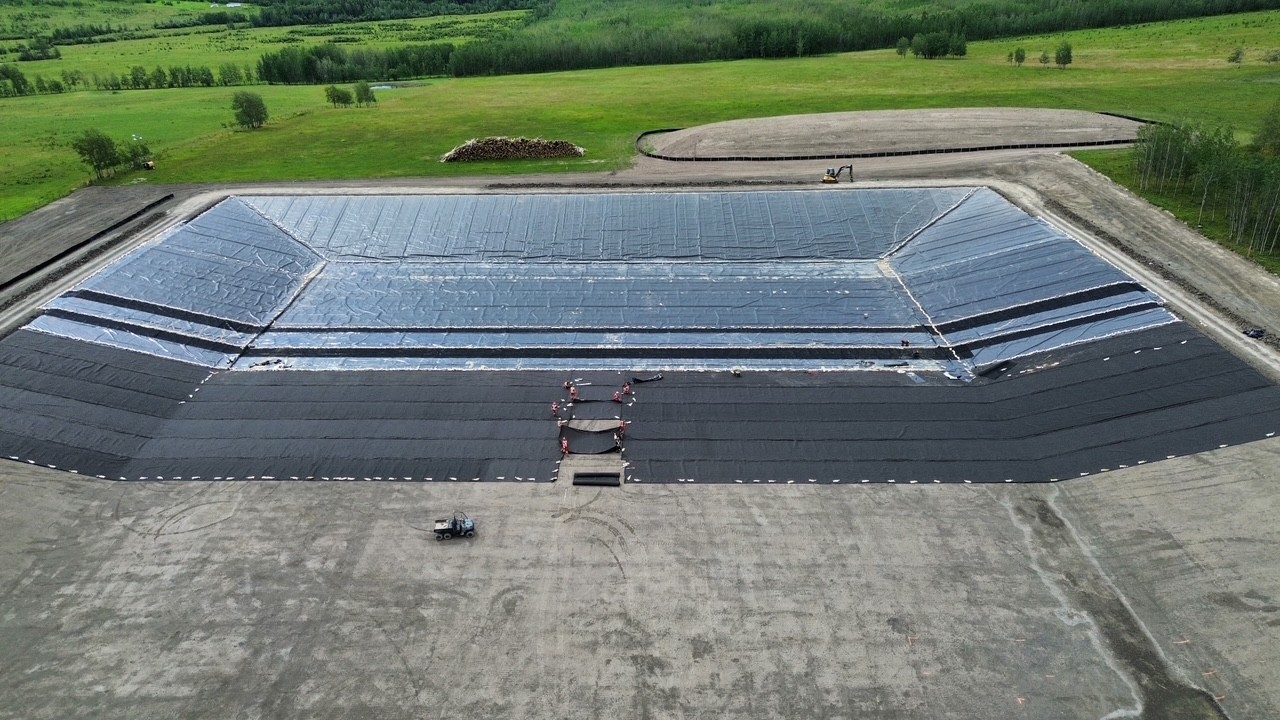
In 2025, Layfield successfully delivered a complex multilayered geosynthetic containment system for a major independent oil and gas exploration company. This included the manufacturing and installation of all the polyethylene geosynthetic components for the project. The system was delivered on time, on budget, with zero safety or quality incidents. It formed a key component of a large, produced water hub supporting hydraulic fracturing operations in the Montney shale gas play of northeastern British Columbia.
PROJECT SCOPE
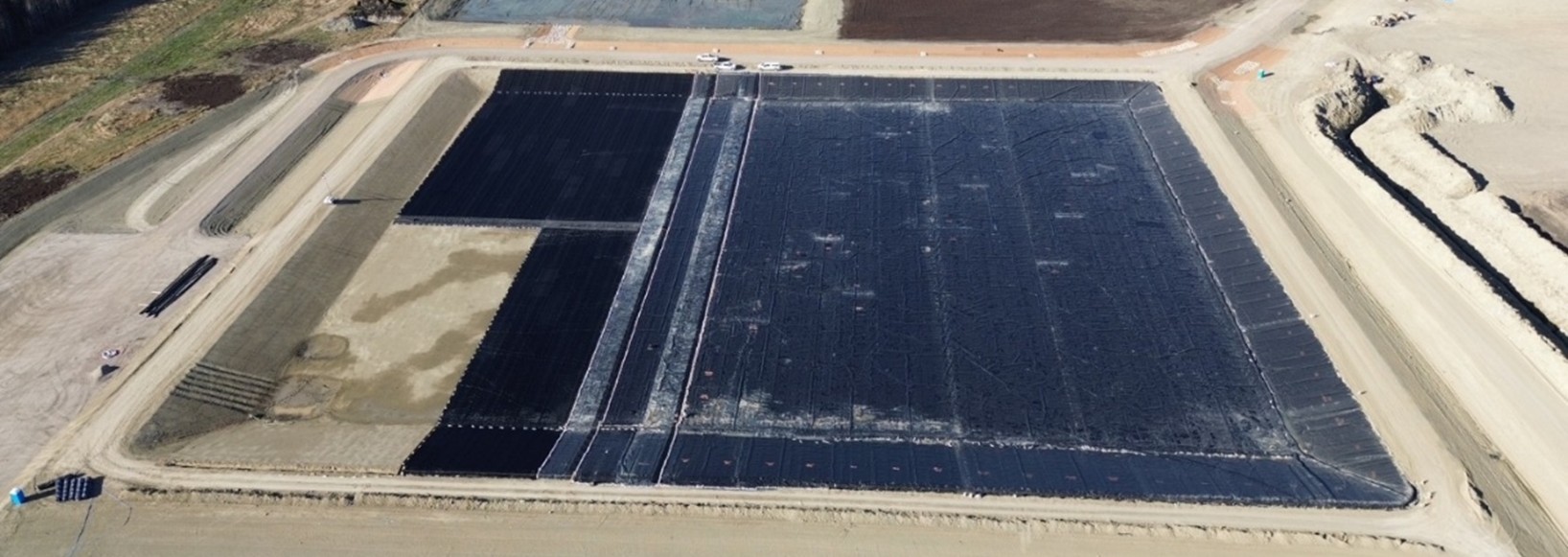
Due to the long-term service life of this produced water pond and its location in a sensitive environmental region, the design incorporated a robust six-layer geosynthetic system consisting of geomembranes, geocomposites, and geonets. Each layer underwent rigorous manufacturing and construction quality assurance and testing. Approximately 25,000 m² (270,000 ft²) of geosynthetic material per layer was installed.
Geosynthetic System (Bottom to Top)
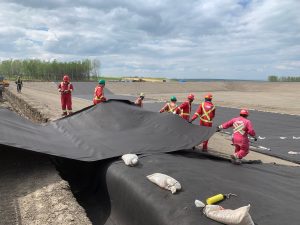
- HydraNet® Geocomposite 220 2 8 – Drainage cushion layer
- Enviro Liner® 6060 Geomembrane (1.5 mm) – Tertiary liner
- HydraNet® Geonet 220 mil – Secondary leak detection layer
- Enviro Liner® 6060 Geomembrane (1.5 mm) – Secondary liner
- HydraNet® Geonet 220 – Primary leak detection layer
- Enviro Liner® 6160 Geomembrane (1.5 mm), Single Sided Textured – Primary liner
PROJECT CHALLENGES
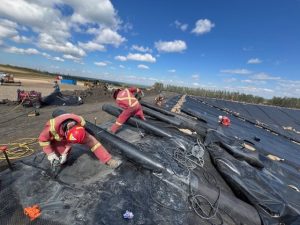
Despite occurring during summer months, construction was impacted by unseasonably high winds and multiple rain events. Installing several geosynthetic layers in sequence required careful coordination and some unique operational considerations, including:
- Extensive ballasting to secure exposed materials
- Ongoing site dewatering to maintain stable subgrade conditions.
- Careful coordination of material staging and deployment
Through adapted field strategies and strong onsite coordination and project management, the project maintained its schedule and quality objectives.
MATERIAL SELECTION
The owner selected the Enviro Liner® 6000 series due to its proven 20 year performance history in Canadian upstream oil and gas applications. Key advantages include:
- High resistance to concentrated brines, typical of produced water storage.
- Blended polyolefin formulation (HDPE + LLDPE) for an optimal balance of flexibility and durability.
- Advanced antioxidant and UV stabilization package for long-term exposed service.
- Superior multiaxial performance, allowing the liner to accommodate settlement, soil deformation, and compaction stresses.
- Thermal endurance properties, including cold temperature stress crack resistance.
The combination of strength, toughness, chemical resistance, and long-term durability made Enviro Liner® 6000 the preferred choice for this demanding containment environment.
PROJECT SAFETY
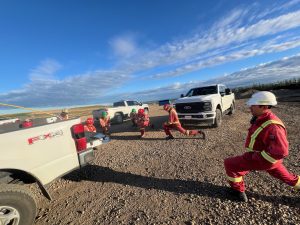
Stringent safety practices remained a core requirement consistent with oil and gas industry standards. Site access protocols required full PPE, First Aid certification, H₂S training, and WHMIS compliance. Over the course of the project, Layfield:
- Conducted fifty-one toolbox meetings.
- Completed two work site hazard assessments.
- Accumulated 4,200 field hours with zero onsite safety incidents.
These results reflect Layfield’s continued commitment to safety excellence in oil and gas environments. The project recorded no safety infractions or lost time incidents.
PROJECT QUALITY
Quality assurance included destructive and non-destructive seam testing across all three geomembrane layers. In addition to conducting standard peel and shear testing of field steams, non-destructive testing included air channel pressure testing of all thermal wedge welded seams, vacuum box testing of extrusion fillet T-seams, patches, and pipe penetrations. Layfield also performed Vacuum Acoustic Leak Identification (VALID) testing on the multilayer system.
VALID is specifically designed for multilined containment facilities. The process is as follows:
1. Seal the top and bottom geomembranes at the perimeter.
2. Apply a vacuum to the interstitial zone between liner layers.
3. Use ultrasonic microphones to scan the surface for acoustic signatures of vacuum leaks.
This method allows simultaneous testing of both primary and secondary liners, enabling precise identification of defects in complex, multilayered systems.
PROJECT RESULTS
Construction began in June 2025 and was completed in August. Layfield manufactured the Enviro Liner® 6000 geomembrane in Richmond, BC, and the HydraNet® geonet and geocomposite in Edmonton, AB. The installation was completed by Layfield’s Canadian construction team based in Edmonton, AB. The project was delivered on time and on budget, with zero safety or quality incidents.
Family-owned and operated for the past 48 years, Layfield Geosynthetics has proudly supported the North American oil and gas sector with industry-leading service, innovative materials, and an unwavering commitment to quality and safety. We serve customers worldwide with our core business in Canada, the United States, and Australia. Call us for your next geosynthetic containment project. We’d be happy to help!