
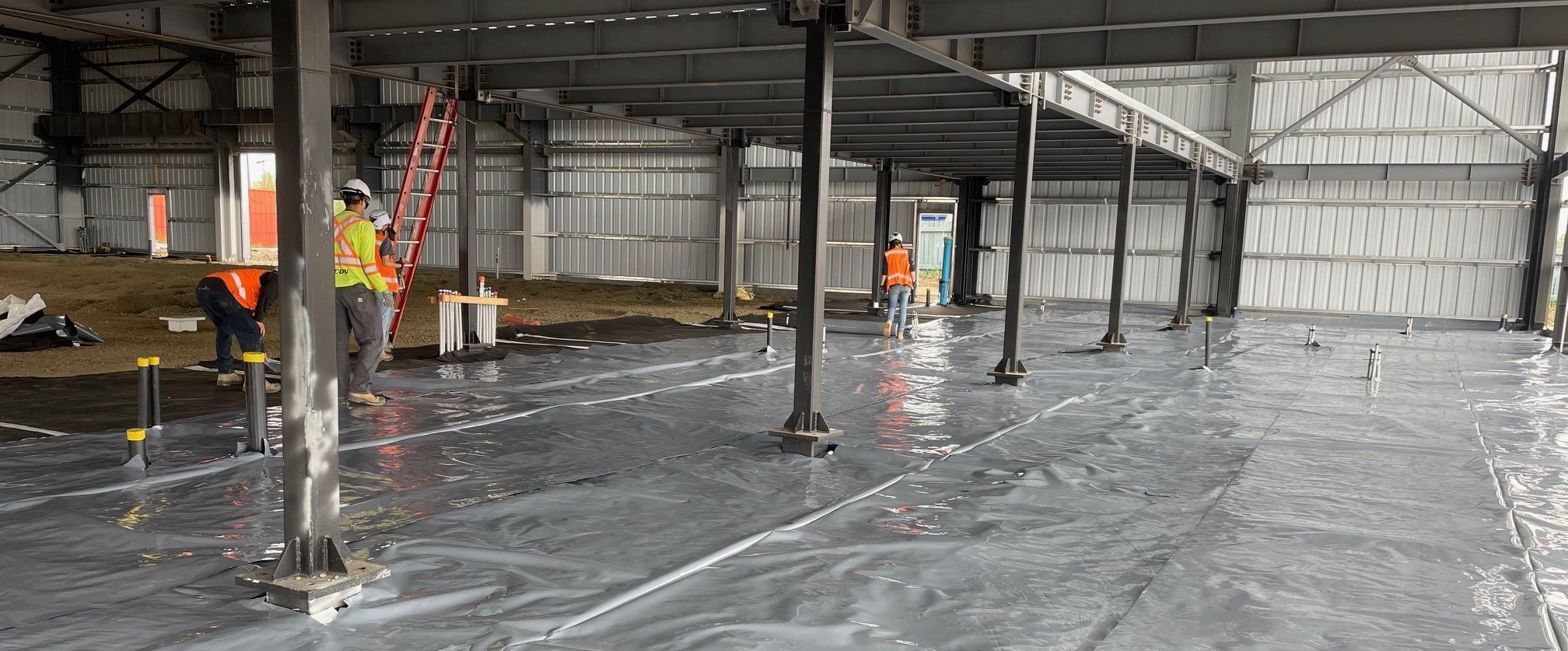
HydraNet laid out, VaporFlex in place, and taped.
PROJECT SUMMARY
A radon mitigation project required a cost-effective and environmentally responsible alternative to traditional radon mitigation methods. Working with the installer, the project team sought to eliminate the need for imported radon rock while maintaining effective sub-slab gas collection and transmission. The project demonstrated how advanced geosynthetic solutions can simplify installation, reduce material requirements, and minimize environmental impacts without compromising performance.
SOLUTION
To address these challenges, the installer used a combination of Layfield’s VaporFlex® Premium geomembrane and HydraNet® biplanar double-sided geocomposite. Rather than installing a traditional radon rock layer, HydraNet® was placed beneath the VaporFlex® to create a highly efficient gas-transmission layer.
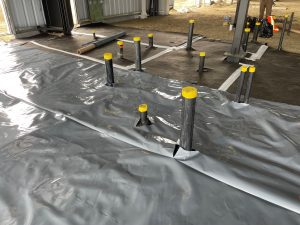
The HydraNet® geocomposite features an internal biplanar geonet that allows gases to move freely beneath the slab, while nonwoven geotextiles bonded to both sides provide separation and help prevent clogging. Combined with the Vaporflex® Premium gas barrier geomembrane, the system created a complete radon mitigation solution that replaced aggregate-based methods with a lighter, engineered geosynthetic alternative.
This approach reduced material-handling requirements and simplified installation while maintaining the performance required for effective radon mitigation.
CHALLENGES & RESULTS
Traditional radon mitigation systems typically rely on a layer of radon rock installed beneath a sealing geomembrane. While effective, this approach can introduce high costs and logistical challenges. Radon rock may be difficult to source, subject to supply constraints, and expensive to transport and install. In addition, the movement and placement of large volumes of aggregate can create scheduling delays, increase equipment usage, and add considerable environmental impact throughout the supply chain.
The project team was looking for a solution that would provide effective gas transmission while eliminating the need for radon rock altogether, reducing both project costs and installation complexity.
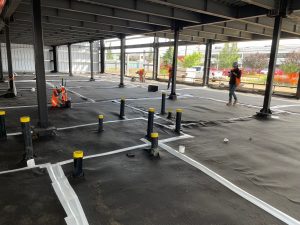
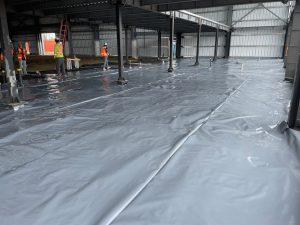
The project delivered substantial savings compared to conventional radon rock installations. By eliminating the need for imported aggregate, the system reduced material costs, transportation requirements, and site handling activities. Although installation still required attention to details such as pipe penetrations, taping, and geomembrane sealing, overall efficiencies and cost reductions were significant.
Beyond cost savings, the project achieved important environmental benefits. Removing the need to quarry, transport, and place radon rock greatly reduced the project’s environmental footprint. The HydraNet® and VaporFlex® solution demonstrated that engineered geosynthetics can provide effective radon mitigation performance while lowering both project costs and environmental impacts.


