Designing seals that survive powders, oils, and high‑speed filling
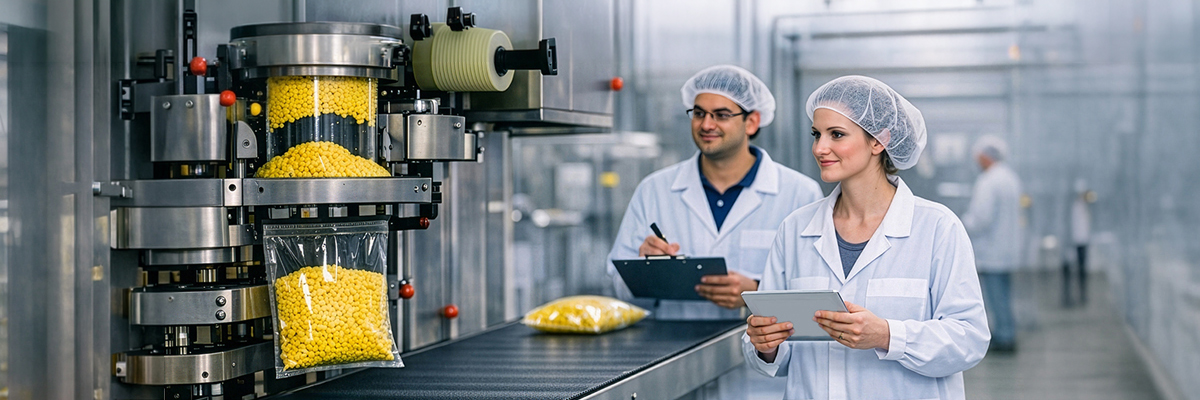
In controlled lab environments, sealing performance can look consistent and predictable. On the production floor, however, conditions are rarely ideal. Powders, fines, seasonings, oils, and even humidity can interfere with seal formation, introducing variability that challenges package integrity.
When seals fail during distribution or leak on shelf, the impact is immediate. Product loss, customer complaints, and brand perception are all at risk. For brand owners and packaging engineers, designing seals that perform under real-world contamination is not optional, it’s essential.
Start with the Science
Hot tack: holding strength before the seal sets
Hot tack refers to the strength of a seal immediately after the sealing jaws open, while the polymer is still molten or semi-molten. In high-speed packaging applications, this characteristic is critical.
If hot tack is insufficient, seals may pull apart before they fully set, particularly under the load of heavier products or rapid vertical form-fill-seal (VFFS) cycles. Ensuring adequate hot tack performance helps maintain seal integrity even before the seal has fully cooled.
Seal-through contamination: sealing despite product in the seal area
In many applications, complete cleanliness at the seal interface is difficult to maintain. Powders can settle, oils can migrate, and particulates can become trapped in the seal area.
Seal-through-contamination performance refers to a film’s ability to form and maintain a seal despite these interferences. This capability depends on both material selection and sealing conditions.
Practical Steps for More Robust Seals
Improving seal performance under contamination requires a combination of material design and process control:
- Choose the right sealant layer
Select sealant structures designed to perform across a wider sealing window. Materials with appropriate melt characteristics can improve both hot tack and contamination tolerance. - Tune coefficient of friction (COF)
COF influences how materials move through forming collars, belts, and sealing jaws. Balanced COF can help reduce product interference at the seal area while maintaining machine efficiency. - Run a seal robustness plan
Test sealing performance across a range of temperatures, pressures, and dwell times. Evaluating performance at the edges of the sealing window can reveal potential risks before full-scale production. - Instrument trials
Use test methods such as hot tack and seal strength measurements to quantify performance. These provide data-driven insights into how materials behave under different conditions. - Validate at production speed
Lab testing is only part of the picture. Confirming performance on-line, at full speed and with actual product, is critical to understanding real-world seal behavior.
Film and Format Considerations
Different product types introduce different sealing challenges:
- For oily or greasy products
Oils can migrate into the seal area, interfering with adhesion. Films should be selected and validated for their ability to maintain seal strength under these conditions. - For powders and dry goods
Powders and fines can become trapped in the seal interface. Structures that support seal-through-contamination performance are important in these applications. - Mechanical properties matter
Beyond sealing, film stiffness and tear characteristics contribute to overall package performance. These properties should be evaluated alongside seal integrity to ensure consistency throughout distribution.
Packaging Line Playbook
Even the best film structure can be compromised by inconsistent line conditions. A few operational practices can help maintain seal quality:
- Maintain clean sealing jaws to reduce buildup that affects heat transfer and seal consistency
- Audit belts, forming collars, and guides to ensure proper material handling and alignment
- Monitor environmental conditions, including humidity and product temperature, which can influence sealing performance
Consistency in these areas supports repeatable, reliable seals.
Where Layfield Flexible Films Fits
At Layfield Flexible Films, our focus is on designing and qualifying film structures that perform in real production environments.
This includes solutions such as Vertiflex™ VFFS films and Lidflex™ lidding films, where sealing performance is tuned for application needs, including conditions where contamination may be present. Development is supported by a combination of lab testing and on-line trials to help ensure materials perform as expected on the packaging line.
Explore Layfield’s lidding and forming film capabilities:
Related Articles
View All News