Packaging trends rarely arrive as finished solutions. They become standards only after an idea proves that it can create value, run reliably, protect the product and fit the realities of manufacturing and recovery systems.
Resealable features, post-consumer recycled content, mono-material structures and digital printing all followed different routes into the mainstream. Yet the pattern behind their growth is remarkably similar: a specific problem creates an opening, early users test the idea, suppliers improve it, and the broader market gradually builds confidence.
For brand owners, converters and packaging teams, understanding that pattern is useful. It helps separate a promising direction from a passing novelty, and it highlights the work required to move an innovation from a compelling sample to a dependable commercial specification.
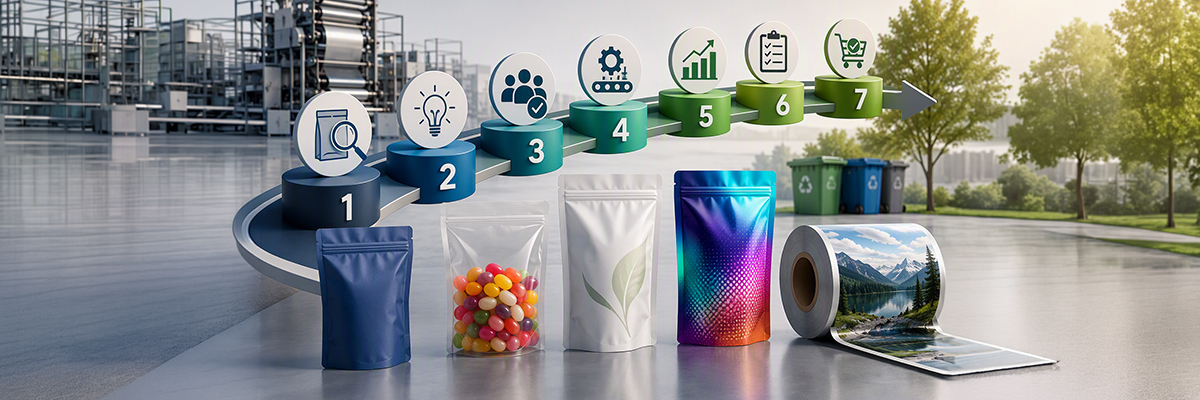
The Seven-Stage Journey from Idea to Standard
| Stage | What changes | The question the market asks |
| 1 | A niche problem appears | Is the current package creating a costly or frustrating gap? |
| 2 | An early solution is introduced | Does the idea solve that problem for a specific product or user? |
| 3 | Early adopters test it | Can the benefit survive real filling, distribution, shelf-life and consumer use? |
| 4 | The supply chain adapts | Can materials, equipment, artwork, quality systems and recovery pathways support it? |
| 5 | Economics improve | Can it deliver value at a repeatable commercial scale? |
| 6 | Proof becomes portable | Can the learning be standardized across products, plants and markets? |
| 7 | The feature becomes expected | Does the market now view its absence as a disadvantage? |
The stages are not perfectly linear. An idea can stall, retreat into a niche, or reappear when materials, regulations, consumer expectations, or equipment economics change. Adoption is less like a switch and more like a series of confidence-building loops.
Stage 1: A Real Problem Creates the Opening
A packaging trend usually begins with a job that existing formats are not doing well enough. The trigger may be wasted product after opening, pressure to use recycled content, a need to improve recyclability, or a launch schedule that makes conventional print economics difficult. The idea gains traction because it answers a concrete need, not because it is new.
This is why the same feature can mature at different speeds across markets. A resealable closure may be essential for shredded cheese or pet treats, but unnecessary for a single-use portion. A simplified PE structure may be promising for dry or frozen applications, while a highly oxygen-sensitive product may still require a more complex barrier system. The problem, product and use case determine the pace.
Stage 2: Early Adopters Turn a Concept into Evidence
Early adopters accept more uncertainty in exchange for a potential advantage. They may value a better user experience, a clearer packaging claim, more responsive artwork changes or an opportunity to learn before competitors. Their most important contribution is not simply being first. It is producing evidence.
- Consumer evidence: Do people notice, understand and use the feature correctly?
- Operational evidence: Does the material unwind, form, fill, seal and cut consistently on the intended equipment?
- Product evidence: Does the packaging preserve quality throughout the required shelf life and under the distribution conditions?
- Commercial evidence: Does the benefit justify any added material, tooling, qualification or supply-chain complexity?
- End-of-life evidence: Are recyclability or recycled-content claims supported for the actual package and market?
IMPORTANT DISTINCTION
A successful pilot proves that an idea can work. A trend begins to scale only when teams can explain why it worked, where it will not work and how to repeat the result.
Stage 3: The Invisible Infrastructure Catches Up
Consumers see a zipper, a recycling label or a new graphic. Behind that visible change is a much larger system. Resin and film suppliers, closure manufacturers, printers, converters, equipment builders, testing laboratories, brand teams, retailers and recovery programs may all need to adjust.
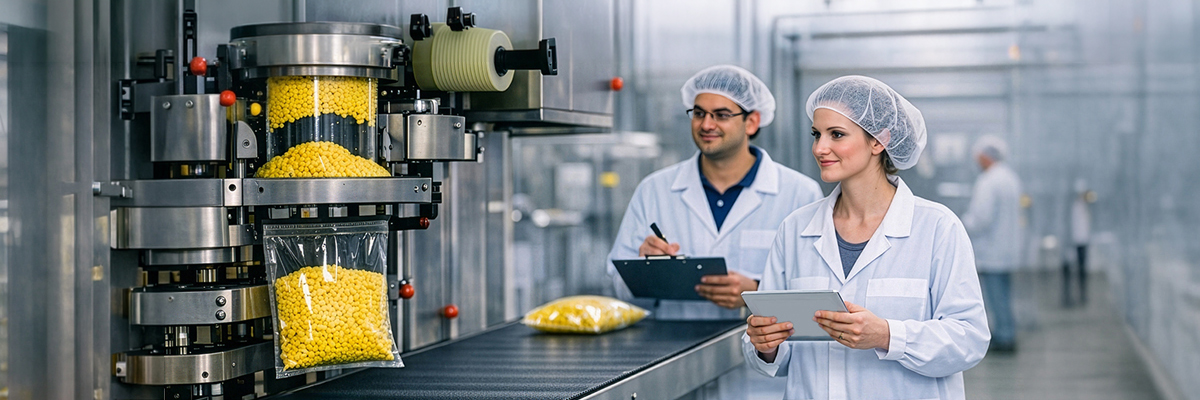
That supporting infrastructure is often what separates an interesting package from a scalable one. A feature has to be available in dependable supply, converted within realistic tolerances, validated against product requirements and communicated accurately. It also needs quality checks that can catch variation before a line stoppage or field issue occurs.
In flexible packaging, this systems view is especially important because one layer or component can serve several jobs at once: stiffness, sealability, barrier, toughness, printability or compatibility with a recovery stream. Changing one element can affect the rest of the structure.
Four Trends, Four Different Adoption Stories
1. Resealable Features: From Added Convenience to Expected Function
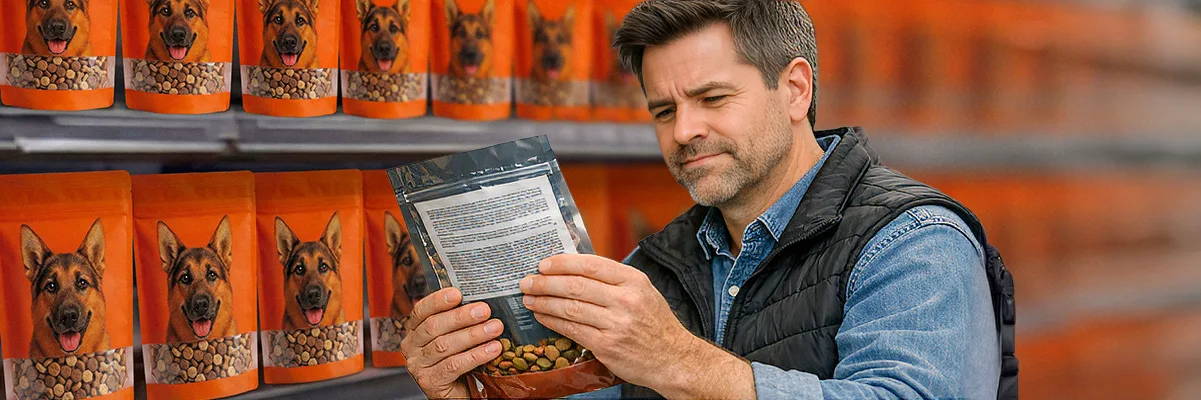
Resealable formats grew out of a simple consumer problem: many products are used on multiple occasions, while the original packaging was designed mainly for the first opening. Zippers and other reclose systems helped preserve usability after opening and reduced the need for clips or secondary containers.
The feature moved toward the mainstream as converters improved closure integration, filling equipment became more capable, and brands learned where consumers valued it enough to influence preference. It also had to prove that the closure would remain aligned, survive filling and distribution, and work without undermining seal integrity elsewhere on the package.
The lesson is that convenience becomes a standard when it is reliable enough to disappear into the experience. The consumer should not have to think about the engineering behind a reclose feature. It simply needs to work, repeatedly.
2. PCR Content: From Material Story to Specification Discipline
Post-consumer recycled content began as a way to put recovered plastic back into productive use and reduce reliance on virgin resin. As interest grew, the conversation became more technical. Packaging teams had to evaluate the source and consistency of PCR, regulatory suitability, appearance, odour, processing behaviour and the performance demands of the application.
That shift matters because PCR is not one uniform input. A percentage on a specification does not, by itself, predict how a film will look or run. Adoption advances when resin quality, formulation knowledge, processing controls, and claims documentation become sufficiently dependable for repeat business.
Layfield offers PCR PET, PCR HDPE and PCR LDPE/LLDPE options. The practical value lies in matching the material and content level to the application rather than treating recycled content as a universal drop-in choice.
3. Mono-Material Structures: Simplifying Polymer Families, Not the Engineering
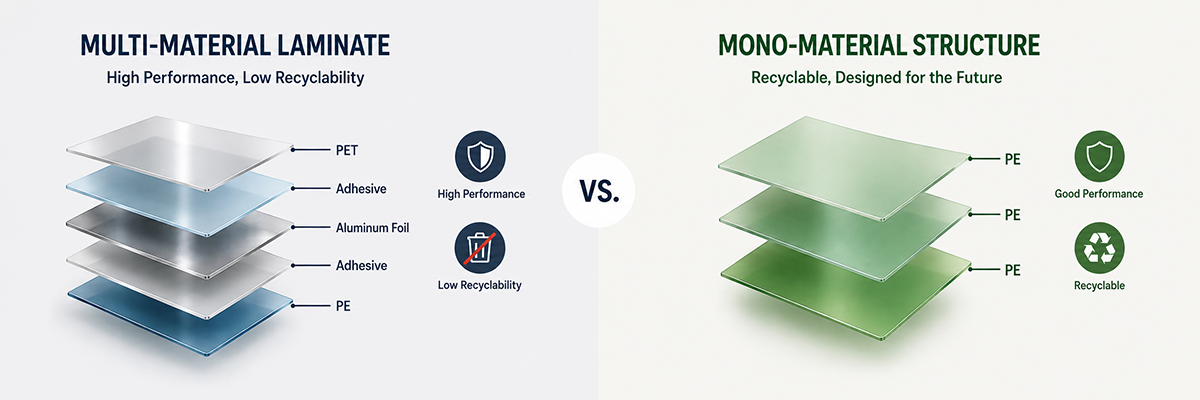
Mono-material is sometimes interpreted as a simple, single-layer film. In practice, flexible packages described this way may still be multilayer structures but are designed predominantly around one polymer family. The objective is to retain the functions a package needs while improving alignment with an applicable recycling stream.
This trend illustrates why market language becomes more precise as an idea matures. Early discussion may focus on the broad promise of recyclability. Commercial development must address barriers, seal windows, stiffness, puncture resistance, optics, inks, adhesives, closures and local collection realities. The Association of Plastic Recyclers notes that PE flexible films can be single- or multi-layered and that every package design feature must be assessed for its effect on recyclability.
Layfield’s own guidance reflects the same balance: mono-material structures can be well-suited to applications with moderate barrier needs, while more sensitive products may face trade-offs among oxygen or aroma protection, shelf life, machinability, and aesthetics.
4. Digital Printing: From Short-Run Tool to Learning Platform
Digital printing first gained attention in packaging for practical reasons: shorter runs, fewer conventional prepress steps and faster artwork changes. Those capabilities made it useful for emerging brands, regional versions, test markets, seasonal graphics and products with many SKUs.
Its broader influence goes beyond print method. Digital production can change how a brand learns. Smaller commercial quantities can reduce the commitment required to test a design or launch a targeted version. Recent Flexible Packaging Association coverage describes digitally enabled production serving stand-up pouches, rollstock and labels for brands seeking short runs, rapid artwork changes and faster replenishment, with the technology also moving into larger-volume programs.[4]
Digital printing will not replace every conventional process. High-volume, stable designs may continue to favour established methods such as rotogravure or flexography. The important trend is a more flexible print ecosystem in which technology is selected based on run length, graphics, change frequency, finish, lead-time requirements, and total economics.
Why Some Innovations Stall
Not every strong idea becomes a standard. The most common obstacles are not a lack of imagination, but an incomplete fit between the idea and the system around it.
- The benefit is visible, but the operational cost is hidden.
- The material works in a laboratory but not across normal process variation.
- The package improves one metric while weakening product protection or line efficiency.
- The claim gets ahead of collection access, testing or documentation.
- The solution depends on a single supplier, a narrow processing window, or a difficult-to-source component.
- The organization launches broadly before learning from a controlled application.
The healthiest response to a stalled concept is not always abandonment. Sometimes the right move is to narrow the application, improve the structure, wait for infrastructure to develop or redefine the value proposition.
The Layfield Flexible Films Lens: Innovation as a Cross-Functional Process
For a vertically integrated flexible packaging manufacturer, the useful question is not simply, “Can we make this?” It is, “Can this be designed, produced, printed, converted and supported consistently for the customer’s application?” Layfield’s capabilities span film design, extrusion, printing, lamination, slitting and converting, creating opportunities to evaluate how a change behaves across multiple stages rather than in isolation.
That perspective is particularly relevant when an emerging trend affects several performance requirements simultaneously. A recyclable-design structure may affect stiffness and sealing. PCR may affect appearance or processing. A reclose feature may influence filling speed and package geometry. A new print route may change artwork workflow and order strategy. Cross-functional collaboration helps surface these interactions early.
The goal is not to push every customer toward the newest option. It is to help determine whether an innovation is ready for the product, the line and the market. In some cases, the best answer will be a new structure or feature. In others, it may be an optimized version of a proven package.
A Practical Readiness Test for Brand Owners
Before adopting an emerging packaging direction, teams can ask seven questions:
| Lens | Decision question |
| Problem | What specific customer, operational, regulatory or commercial problem are we solving? |
| Product | What barrier, seal, strength, temperature and shelf-life conditions are non-negotiable? |
| Process | How will the structure behave on the actual filling and sealing equipment, across normal variation? |
| Proof | What testing, trials and acceptance criteria are required before scale-up? |
| Supply | Can the materials and components be sourced consistently at the intended volume? |
| Claim | Can every environmental or performance statement be supported for the finished package and sales market? |
| Scale | What must become standardized so a successful trial can be repeated across orders, SKUs or plants? |
What the Next Standard Will Have in Common
The next widely adopted packaging feature may come from materials science, printing, smart packaging, closures, automation or a combination of them. Whatever the technology, its path will likely resemble the trends that came before it.
- It will solve a recognizable problem.
- It will be validated in a focused application before expanding.
- It will require collaboration across the value chain.
- Its claims will become more specific as the market matures.
- Its economics and supply base will improve through repetition.
- It will become easier to specify, test and reproduce.
CLOSING THOUGHT
Industry standards are not created by attention alone. They are built when repeated evidence turns an unfamiliar idea into a reliable choice.
For packaging teams, that is the real value of following trends. The objective is not to be first at any cost, or last because change feels uncertain. It is to recognize when an idea is becoming practical, understand what must be proven, and make a better-informed decision about where it belongs.
Related Articles
View All News